

There is a funny thing about planning a trip to Croatia: many travelers decide they want to visit Dalmatia long before they fully understand what Dalmatia actually is.
The map of Dalmatia that we’re sharing in today’s article will definitely help you decide which part of the Adriatic is for you when visiting the Dalmatian coast. Insider tip: you have a ton of options and they are all amazing!
Stretching along Croatia’s Adriatic coastline for more than 400 kilometers (and 70km wide), Dalmatia is the country’s most visited coastal region and, in my opinion, the part of Croatia that first-time visitors understand the least before arriving.
Looking at Croatia’s map, it looks simple: a long coastal belt packed with beaches, islands, medieval towns, and ferry routes connecting destinations that can look deceptively close together. That’s not really the case.
Some travelers want quieter islands and national parks. Others are chasing the classic Split-to-Hvar route. Then there are those who head straight south for Dubrovnik and never realize how much they skipped along the way.
This guide breaks down the Dalmatian Coast map region by region, showing exactly how Northern, Central, and Southern Dalmatia fit together and, more importantly, what each area is actually best for when planning your trip.

We have various maps below that will offer some in depth views overt he Dalmatian Coast, but if you want to check out Google’s Map of the region, you can do so by clicking here.
The unofficial capital of Dalmatia is Split city, which is also the second largest city after Zagreb, Croatia’s capital.
Northern Dalmatia Map & Info
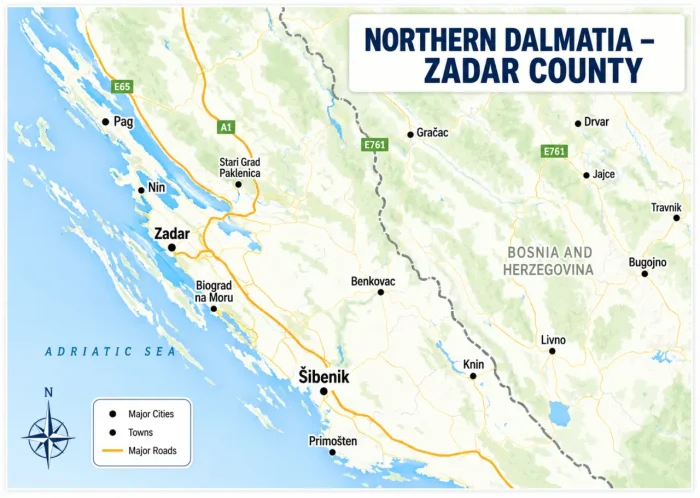
Northern Dalmatia refers to the part of Dalmatia between the island of Pag in the northwest to the town of Primosten in the southeast.
Zadar and Šibenik are the two main cities of this region, and this area includes several of the country’s most famous protected natural attractions, including Paklenica National Park, Kornati National Park, Krka National Park, and the world-famous Plitvice Lakes National Park.
Islands like Pag and Dugi Otok (Long island) are famous off the beaten track destinations for complete relaxation and enjoying nature.
And even though in the Northern region of Dalmatia, it is by no means colder than other beach destinations in the country.
Overall, this is a great area to start exploring in order to discover Croatia’s hidden gems and lesser known – but equally spectacular – attractions.
Central Dalmatia Map – Split County

The Split region is the largest Croatian county with the total area of 14,106.40 km2 . The whole area, including the islands, makes up 8% of the Croatian Republic surface and 30.8% of the sea surface.
So yes, it is large and impressive, being considered one of the main destinations by those visiting the country.
Most of the county belongs to the inland hinterland region, accounting for roughly 60% of the territory, while the Central Dalmatian islands make up approximately 19% of the surface area.
Geographically, it is located in the central part of the Adriatic coast. It stretches from Vrlika in the north to the farthest Croatian island of Palagruza in the south and up to Vrgorac to the east.
Split County, or Central Dalmatia, runs from the historic town of Trogir in the northwest to Ploče in the southeast and includes some of Croatia’s best-known islands, including Brač, Hvar, Vis, and Šolta, all visible on the Central Dalmatia map above.
Only 80 km south of Split lies the famous Makarska Riviera with the most beautiful beaches in the country (at least in my opinion).
Roman ruins, fabulous beaches, old fishing ports, medieval and Renaissance architecture – all these make Central Dalmatia one of the best regions to combine a summer vacation’s sun soaking and swimming with discoveries of historical sites and well known beauties of the country.
South Dalmatia Map
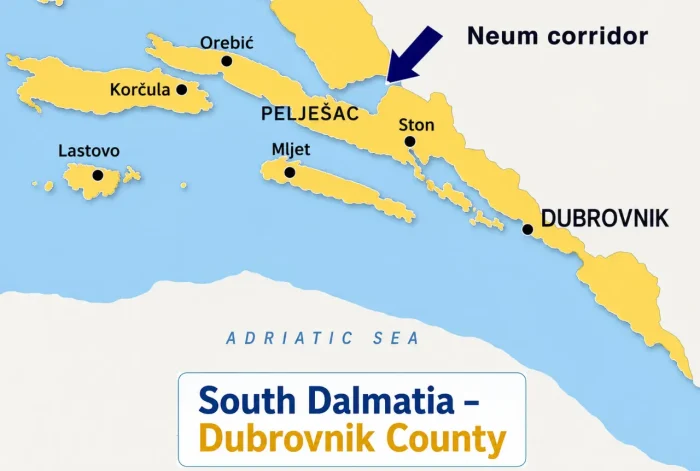
Southern Dalmatia runs from Ploče in the north all the way to Croatia’s border with Montenegro in the south. Compared to the rest of the country, this part of the Adriatic has a slightly unusual geographic layout because of one very specific stretch of land.
This is the Neum Corridor (you can learn more in this Wikipedia article), a narrow section of coastline belonging to Bosnia and Herzegovina, which splits the Croatian coastline in two..
For years, travelers driving south toward Dubrovnik had to cross through Bosnia before re-entering Croatia a short distance later, which created border checks and extra planning complications.
That changed after the opening of the Pelješac Bridge, which now allows travelers to remain entirely within Croatia while driving south toward Dubrovnik (or from it to other cities in Croatia).
This warm and sunny region is a flourishing region of coves, woody islands like Mljet (National Park of Mljet), Korcula island and the Peljesac peninsula, with the main attraction being undoubtedly Dubrovnik, the pearl of the Adriatic coast.
There are only a few cities in the world that can match up to this unique town with its massive city walls and immense artistic heritage available to anyone.
Southern Dalmatia feels more polished, more historic, and in many ways more dramatic than the rest of Croatia’s coastline.
How Long Does It Take to Travel Between Dalmatia Regions?
Since I mentioned earlier the fact that this area is longer than you might expect at first, here are some example travel times from various important destinations on the Dalmatian Coast.
These are extremely important when planning your Croatian itinerary, as simply looking at the map, they might seem close.
| Route | Approximate Travel Time |
|---|---|
| Zadar → Split (driving) | 1.5 hours |
| Split → Šibenik (driving) | 1 hour |
| Split → Makarska (driving) | 1 hour |
| Split → Dubrovnik (driving) | 3 to 4 hours |
| Dubrovnik → Korčula (ferry + transfer) | around 2 hours |
| Split → Hvar (ferry) | 1 to 2 hours |
| Split → Brač (ferry) | about 50 minutes |
Keep these distances in mind (and prepare for some delays, as the roads might be a bit busier during the peak season) if you try to combine too many destinations within a single week.
Wrapping Up
Hopefully these detailed Maps of Dalmatia with extra details about each region will help you a bit when deciding what to see during your trip to Croatia or at least help you get a bit organized.
The map never quite prepares you for how much there is to see once you arrive. And somehow, Croatia still manages to make you wish you had booked a few extra days.